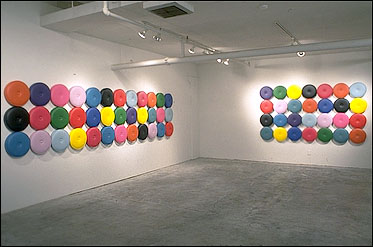
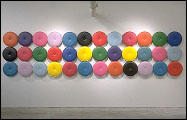
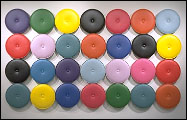
Didi Dunphy For the last ten years, Didi Dunphy has involved herself in the project of "re-making" American modernist art, from Post-War abstraction to the final breaths of minimalism. Specifically, Dunphy has gone about this remaking by delivering genericized versions of the images, designs and forms of American modernism via media which, by their association with femininity, show themselves contrary to the masculinity attached to modernism. Oil paint, a material with no gender, but which has been connected to maleness as the result of an almost entirely male canon of artists who used it—the material of the fathers in a story in which mothers are but a footnote—is replaced with tie-dye and embroidery. Steel and concrete are replaced with upholstered foam. Hard is made soft, rigid made flexible, heavy made light, heroic made modest, drab made colorful and lush.
The result's of Dunphy's efforts are objects that look something like what we might have gotten if, during his early years, Frank Stella had chosen needlepoint over oil on canvas or if, at the apex of minimalism, Carl Andre had opted for arranging seat cushions rather than slabs of steel (and perhaps if he had a flair for color to boot). Thus, there is what might seem a basic reversal at work in Dunphy's appropriation/creations. This kind of read would seem perfectly logical and not off the mark given the abundance of gender-aware revised reading of modernist history, the adoption of appropriation as a popular strategy for questioning links between gender, authorship and canonization, and the establishment of using creative outlets previously relegated to women, and thereby marginalized, as reclaimed and thereby empowered means expression (traditional "women's work" becomes traditional feminist practice). To view Dunphy's output as a riffing on masculine precedents, however, is to limit the work to serving as a self-congratulatory stand-in, assuming an enlightened superiority to, but forever dependent upon the canonization of the precedent it seeks to topple.
To me, Dunphy's work is not about toppling or even necessarily revising, and thankfully so. After all, disappointing as the western canon might be in its exclusiveness, the problem would seem to lie more with glaring omissions and skewed or limited interpretations than with misguided admissions. There are more than a few inclusions in the canon that arguably need to be revisited in terms of how and why they are valued and understood within culture, but I can't imagine two many of the canon's inclusions that I would want to remove and replace. Rather, I see a need to weave back into the text, to add chapters, to revise/rewrite. Such revision, as I see it, however, is better handled through information and education than through aesthetics, and while I have enjoyed many a work of art with a heavily informational, educational, even ideological aspect, I have generally preferred in the end to walk away from a work of art feeling not so clear as to what I've been told, but rather left wondering what to think. It seems to me that it is under such circumstances that the possibility for learning or understanding most profoundly kicks in—when the work of art becomes not a closed container holding a finite set of ideas, but rather the stimulus for new and ongoing thinking.
Dunphy's works actually point to themselves much more than they point art-historical precedents, and they do so by tweaking at the definition of what we might call appropriation or quotation. Dunphy doesn't show photographic or digital copies of originals created by other authors, nor does she offer painstakingly handmade replicas. In fact, as the result of changes in scale, color and material, her works are often notably distant from their "source" material. Moreover, they tend to mimic in ways that might seem specific, but that are actually rather general. Thus, her works might display vague stylistic similarities to a precedent, like a certain manner of handling line, or they might take advantage of a device held in common with a precedent, like the composing of elements according to a grid, or they might involve a maneuver that echoes a precedent, like arranging elements on the floor. The simple fact is that while we might look at Dunphy's works and note the names of other authors of other work, perhaps particular periods in their careers, a certain series, or even a particular piece, Dunphy's work don't look like these precedents nearly so much as her works—in degrees ranging from somewhat to vaguely—have the look of these precedents. This might seem like hair-splitting, but it's a key distinction. Dunphy might begin with very specific referents in her mind while creating her works, but when the finished pieces are passed off to the viewer, they are suggestive while ultimately unclear as to their references.
Yet one tends to look for, and believe one has found, clear references, pointed agendas, even spelled-out meanings in Dunphy's works, and this is where things kick into play. Play, for me, is an important word here, because play, as a whimsical and lighthearted or potentially mischievous, even devious approach to art and objects and images, seems essential to this work, as does play as a slippage or looseness of meaning. If there seems to be any one core thing Dunphy's works are about (and I believe they are about many things, at least as many as the questions they inspire us to raise) they seem to be about our need to identify and categorize objects and images and their attributes and qualities in terms of culture, history and gender.
The context of the gallery naturally encourages one to look for art-historical associations with Dunphy's works, but this search tends to lead to interesting questions rather than dull certainties. Do we need precedents, and if we do, can we assuredly locate them? Are the precedents necessarily male (Carl Andre's floor arrangements) or could they be female (Miriam Schapiro's patterns), and do either of these precedents actually have their own gendered qualities? Are Andre's floor pieces masculine because they are steel, because they are made by a man, because they are privileged within a patriarchal culture? Are Schapiro's patterns feminine and/or feminist because of the sex of their creator, because of the context into which they were received, or because of some aspect they actually carry? Might Dunphy's works be critiques or homages or both, and of and/or to what ultimately? (Is she loving what she hates or hating what she loves, and must we follow along in her disposition?) Why do things as basic as lines seem almost to belong to Frank Stella, and why does the grid belong to modernism instead of nineteenth-century quilting?
Dunphy's works invite broader questions as well about shape, material, color and context. Why might we consider certain colors, color combinations, tints or shades to be masculine or feminine, tasteful or distasteful, belonging to a particular period or style, light or heavy, naughty or nice, youthful or aged? Might they even have a specific meaning or message? Why might upholstery, in this case naugahyde and vinyl, which arguably are somewhat neuter as basic materials, shift gender associations depending on color or form? When and where and how do these things become sculpture instead of furniture, playthings or curiosities, and how do such distinctions affect how we assign value and gender to these objects within culture?
At the end of the day, the little questions Dunphy's works encourage us to ask feed like tributaries into big questions about the nature of art and culture, the construction of gender and history, sexual difference and differencing, and the possibility of clearly understanding or altering any of the above. Those are questions I might take a stab at toward the end of my career, which I hope is far off, as so far it seems to me that everyone who has tried to answer hasn't had a career quite long enough to work it all out. In the short term, I'm happy to have artists like Dunphy making works that keep me asking the questions.
By Christopher Miles, June, 2000