
 |
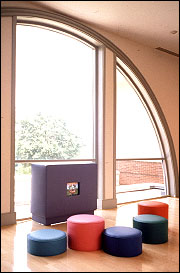 Top: Vinyl Naugahyde upholstery, TV/VCR, speakers. Middle: Shiori Asano, Jumping Lights, 2001, still frame. Bottom: Five seating units, 16" diameter, height varies from 8" to 14". 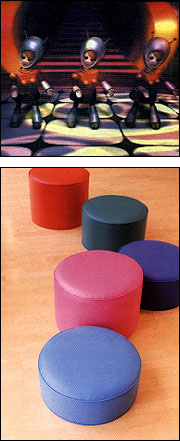 |
Telfair Museum of Art, Savannah
Modern Convenience Departure Lounge: Didi Dunphy in collaboration with Dreamspan, Inc.
Vinyl Naugahyde, foam, wood, TV, speakers, video
Didi Dunphy is a California expatriate and her work clearly reflects a West Coast sensibility and energy that she has brought with her to Georgia. Trained in performance and video, Dunphy is a master cross-pollinator of ideas and genres, making her a natural appropriationist and collaborator. Her work over the past fifteen years has been built upon a conceptual feminist agenda in which she gave herself the "task of re-configuring post-World War II American modernist art" by creating feminized objects that reference masculine art. Accordingly, she has fabricated embroidered abstract geometric designs based upon the work of artists such as Josef Albers, and launched an ongoing series titled Upholstery that made hard-edge paintings (think of Frank Stella) into soft Naugahyde vinyl wall works and sculpture—often with functional qualities.
For the Georgia Triennial, Dunphy has joined with Athens-based artists/curators Beth Hall and Jason Thrasher of Dreamspan, Inc. in a remarkably accessible yet complex collaboration. The Modern Departure Lounge is an upholstered TV with seating units that invites visitors to view a 45-minute compilation of contemporary Japanese short animation works. Dunphy has chosen bright, oh-so-current colors (pinks, purples, yellows and oranges) for her furniture. The wide-bordered television stand and the short stools perfectly complement the highly stylized Japanese cartoons with their familiar "cute" characters, often twisted story lines, bright colors and "super-flat" complex images, moving through space in slow frame animation.
What is going on here? Dunphy has created art works whose domestic and functional qualities, appealing to children of all ages, continue to subvert high art postures. Her goal is to move art outside rarified galleries and into homes, consistent with her feminist agenda. Furthermore, with her collaborators Dreamspan, Inc., she has joined in a dialogue that touches upon globalization, the nature of new media, and the successful morphing of popular culture with high art into a hip, universally understood global language that moves from East to West and back again.
The tongue-in-cheek, ironic tone of Modern Convenience Departure Lounge has somewhat shifted, however, since September 11th. To some degree, we should enjoy this piece for what it is: a joyful and entertaining escape. While indulging in such activities did not seem relevant in Fall 2001, time has allowed us to see the value of therapeutic pleasure. On the other hand, we cannot deny that the lounge in its entirety is a reflection of the trend-setting prosperity of the late 1990s and the invasion of new media into all aspects of our lives. The artists intended for us to be cognizant of this when the lounge was first conceived in 2000-2001. Now, in our new world that seems both larger and smaller at the same time, Modern Convenience Departure Lounge reminds us of the far-reaching and ponderous impact of globalization, even as we are delighted by our access to other cultures.