
Art Papers Magazine
July/August 2001
Lizzie Zucker Saltz
Athens
 |
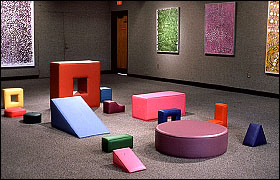 Carol John and Didi Dunphy, "Pop Tarts" (installation view), 2001, dimensions variable (photo by Carl Martin). |
In "Pop Tarts" (Tate Gallery, University of Georgia, March 19-April 5), CAROL JOHN and DIDI DUNPHY's pop-culture mutations complimented each other. While John plucks design icons out of the zeitgeist and recontextualizes them as fine art, Dunphy plucks Modernist icons out of the history bin and reconstitutes them as pseudo-practical, retro-design. Both deflate fine art pretensions while inflating design.
Blurring the line between art and design is second nature for John, who has worked for the progressive Athens design firm, D.O.C. Unlimited, Inc. since 1994. John's previous oil on paper works layered giddy emblems, such as daisies or smiley-faces. A bit self-conscious, the new works shake it off, a shift which John credits to viewing Yayoi Kusama's hypnotic paintings. They also led her to that ubiquitous and recently revived pop motif, the polka-dot. Her new works, which are as modestly scaled as her older work—though tonally modulated in a potent manner—suffer from claustrophobia. The dots push against the edges, packed into crowded grids. But with Big Pink 1-3 (2001), a trio of vertically soaring images measuring a colossal 10 by four feet each, Johns subtle color-play and compositional strengths are given the elbow room they needed all along. Swarms of outlined dots in hot hued glory give a first impression of being lifted from a GAP store display, however their energetic, expansive dispersal endows them with a shimmering, eerie, organic life.
Dunphy, a recent California transplant, brings a formidable sense of humor to her numerous and ambitious conceptual projects (for instance, Barnett Newman Zips remade with real zippers), developed over a decade of exhibiting. "Modern Convenience," the title of her recent series of naugahyde covered, "washable," modular, upholstered wall and floor pieces, epitomizes Dunphy's knack for undermining classic minimalism by imbuing it with the cheerful pragmatism of Post-War American domestic design. Superficially, she resembles fellow West-coast feminist Rachel Lachowicz—whose early-'90s Richard Serras in lipstick smeared the machismo of heavy metal sculpture. Yet not only is Dunphy's work unusually asexual for an avowed feminist, she never appropriates specific pieces, deriving images from the stylistics of canonical male artists. Thus her work is mischievously muddied by moral ambiguity—her send-ups function simultaneously as homage. For instance, the 14-foot long Modern Convenience (2000)—a series of round, piped pillows in vivid red, purple, pink, Kelly green, powder blue, canary yellow, and black Naugahyde—is a tribute to furniture designer George Nelson's 1956 Marshmallow Sofa. But by wall-mounting the pillows in a nine by three grid, it recalls minimalist presentation strategies. As Dunphy is no doubt aware, at this late stage of trickle-down Modernism, the pillows reverb with ignominious hair salons, bringing it cleverly crashing down to earth. Modern Convenience (2001) is a grid of soft rectangles, created for the unique window display of Athens' newest gallery, The Arrow (March 15-April 11). At once a tribute to Ellsworth Kelly and a pneumatic vamp on his aesthetic, it questions the arbitrariness of fine art's material hegemonies. Of course, this question has been begged by feminist artists' employing craft materials from the era of Harmony Hammond right on up to Jim Hodges. What makes Dunphy's take fresh is the bratty ambivalence—plural readings are her strong suit. This is eminently clear in the "Scatter" floor piece, Upholstered Elements (1999-2001). Comprised of 11 miniature "primary structures" in robust, restaurant-booth tones, it reads as a genetic mishap between a day-care center and the Vogel Collection. Dunphy's factory-commissioned units lack the proportional elegance of their models, yet in their cheerful innocence they better fulfill the Bauhaus dream of integrating Modern design into domestic environs.
This connection is made explicit in the wall piece, 5 Upholstered Embroideries (2000-2001), which consists of mod, rounded rectangles with cross-stitched embroideries embedded in their centers. The subtitle Albers leaves us to ponder whether its Anni getting her due or Josef, or both. 4 Samplers (Pink Stellas) (1999-2000), is an earlier version of this particular low art/high art sport, which Dunphy has played since 1995. Simply mounted on embroidery hoops, with all their kitschy country-kitchen charm, these render the point a bit pat. But on her website she has it tweaked to perfection—you can download her Modernist-inspired cross-stitch patterns for your Mac or IBM, complete with instructions and floss color guides for completing your Piet Mondrian pincushion, Gene Davis pillow or Kenneth Noland placemat. Dunphy taints Modernism's oft mocked purity, only to redeem it, American style, by making it useful.
At both galleries, the windows were pocked with five and one-half inch diameter vinyl polka-dots, sold in editions of a dozen, in hot pink, warm yellow and Ho-Jo turquoise and orange. Despite the pun in the title, Static Cling (2001) oozes Boomer nostalgia, evoking Colorforms, the vinyl shapes playset, lacking the other pieces' clear referentiality. It did serve to intensify the kiddie-carnival atmosphere, along with the amusingly performative opening reception at the Tate Gallery where attendees stumbled about in a sickly-sweet haze, slurping chocolate milk through straws out of teeny-tiny cartons and munching hot Pop Tarts served by chipper young women in monogrammed white uniforms who tended the many shiny toasters. Fun and funny, the happening added to an already entertaining exhibit.