
art press
246: expos/reviews
may 99
Jody Zellen
Didi
Dunphy
Post Gallery
12 February 13 March 1999
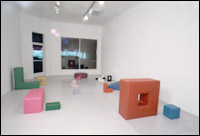
Didi Dunphy's current exhibition at Post pushes her already accomplished work into a new realm. For the last ten years Dunphy has been concerned with the investigation and subsequent reinterpretation of modernist painting using a range of mediums that shy away from traditional painting. Her pieces incorporate ideas and structures from well-known male painters such as Hans Hoffman, Frank Stella and Piet Mondrian, giving their abstract works a new twist through more "feminized" mediums that include tie-dye, needlework and upholstery.
Dunphy's strategy is similar to that of another Los Angeles artist, Rachel Lachowicz, who has created replicas of male artists' work made out of bright red lipstick or other "soft" materials including rubber and eye shadow. In her last body of work, Dunphy carefully represented the painted geometric forms of Stella or Mondrian as tiny circular needlepoints where each stitch mimicked the male artist's brushstroke. In her current exhibition, Upholstery, Dunphy creates the forms of minimalist sculptures-the "L," the open cube and the solid cube-out of soft foam that has been covered with a bright-colored vinyl fabric. These upholstered sculptures are carefully arranged on the gallery floor, appearing like a softer and more feminized version of a minimalist exhibition from the 1960s. The installation is stunning, combining both large and small versions of numerous shapes in colors ranging from primaries, to black and white, to more pastel tones associated with the furniture of the 1950s. In addition to the obvious allusion to Minimalist works, Dunphy's sculptures also refer to children's toys-always soft and brightly colored. Her installation can be viewed therefore in two ways. Either as a room filled with giant children's playthings or as a carefully articulated placement of sculpted forms. It is interesting to compare Dunphy's work with that of wellknown Minimalist sculptor Barry LeVa, whose formal arrangements of sandcast hydrastone blocks are skillfully arranged on the floor of the Richard Telles Gallery in Los Angeles. But where Dunphy's arrangement is playful and casual, LeVa's sculpture represents one configuration of the many possible arrangements of these specific shapes and sizes. LeVa's work is about the relationship between thought (the various possibilities, as seen in the accompanying drawings) and the actual sculpture. Dunphy draws from her Minimalist and Conceptual predecessors, taking their strategies, their forms and their thought processes and infusing them with her own sen-sibilities and feminist agenda. Dunphy¹s intention is to make seemingly minimal works out of soft colorful materials that relate more to domestic space than to the cold, stark world of the foundry.