
John Rapko
Glitter
and Tie-Dye
Janis Provisor and Didi Dunphy at SFAI
Since Cicero, the visual arts have been linked with the celebration of the powers of the human hand. The use of the hand symbolizes all that distinguishes human beings from other animals; it mediates between reason and the world, and manifests the mind's peculiar dignity. In the mid-eighteenth century, William Hogarth's Analysis of Beauty laid out the characteristically modern sense of the hand in art Hogarth insisted upon making a connection between the pictorial mark and the hand that made it. This gestural sense of the mark has been combined with the modernist artist's need to establish authority through a characteristic stylistic originality. The pictorial mark reveals a unique subjectivity, which in turn animates the mark. Abstract expressionism has come to epitomize the sense of the brushstroke as a unique gesture, although the pervasive contemporary questioning of the possibility of originality or authenticity in cultural production reflects the gestural sense of the mark along with the ideologies of abstract expressionism. Rumor has it that the hand is passé.
In a recent show at the San Francisco Art Institute, curator Jean-Edith Weiffenbach assembled work by two artists who examine the death of the hand. Janis Provisor offers her paintings neither as spatial illusions nor as a created realm of self-expression, but, rather, as a kind of ornament built out from the plane of the support Each painting has a silver or gold surface brushed broadly over black underpainting. On top of this shimmering background, she drops blobs of opaque paint or fills the surface with calligraphic white skeins. There is no depth in any traditional sense; the black underpainting functions only to set off the metallic pigment, and to check the tendency of their glittering light to spread forward. This procedure creates two uncommunicating visual planes: a surface and an area of pictorial incident slightly in front of it. The effect is like a sharply etched low-relief metallic sculpture with painted highlights.
Provisor draws upon abstract floral and arboreal motifs to guide her hand. Unlike many semi abstract works, these paintings don't attempt to reconstruct the mood of a landscape from memory. Instead, the motifs provide a springboard for calligraphic flourishes and are a device for filling the surface when invention gives out. The energy of the brushstroke remains locked in the forward plane and seems to spread only horizontally or vertically, and so the fundamental metaphor for Provisor's paint is that of a spreading accretion. Consequently, juxtaposition and filling-in are her compositional techniques; Provisor then uses multiple canvases in an attempt to add authority and weight. Treating the canvas as an ornament allows her to retain a limited gestural fluidity, but because she remains bound to traditional pictorial concerns, compositional problems arise.
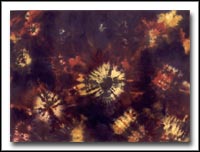
Didi Dunphy, on the other hand, approaches painting from the outside. Trained in performance and installation art, Dunphy views painting primarily as an artifact whose cultural functions need investigations. Here, she showed three large works from what she calls her "expressionist" series. Each canvas is densely stained with tie-dyed colors, creating a dark weave of undiluted color with some accidental sunburst or floral patterns. Dunphy then coats the picture with a thick, smooth layer of varnish, which seems to push the surface away from the viewer. The colors are preserved but inaccessible, like a prehistoric butterfly encased in amber. This is painting as embalming.
Dunphy describes these works as showing "the truth of gesture.² If so, it is like calling death the truth of life. Much more radically than Provisor¹s paintings, Dunphy's work blocks the viewer's attempt to linger upon the sensuousness of the color and to read bodily expression from pictorial incident. Dunphy is investigating the process of stylization through which the expressive gesture becomes a commodity. Just as tie-dyed shirts became a marketable synecdoche for counter cultural attitudes, so Abstract Expressionism became the one preemmently American gestural style within the cultural market. Dunphy¹s paintings are distanced allegories of this process.
Weiffenbach's pairing of these very different artists is meant to show two routes for painting after the collapse of the gestural sense of the brushstroke. For Provisor, work-ing within the pictorial tradition, painting is seen as a particularly prized kind of decoration which sus-tains focal perceptual awareness; for Dunphy, working outside the picto-rial tradition, painting is seen as a particularly dense artifact at the intersection of cultural practices. Both artists accept that the era of the gestural mark and the contemplative concern with pictorial depth is over. Their moral is that painting as a dis-tinctive art cannot survive the death of the hand.