
Artweek April
1999
Reviews
Rick Gilbert
Didi Dunphy at POST wilshire
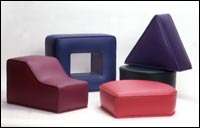
Legend has it that at a cocktail party around 1964, Andy Warhol was asked to stack ten Campbell's soup cans in a pyramid atop a coffee table. For the creation of this "instant sculpture," he was paid $500. Does the "sculpture" still exist? Was it signed? Has it been disassembled, reassembled, exhibited elsewhere? Have the cans been gutted of their contents and resealed to prevent botulism? Contemplation of Didi Dunphy's Upholstery, a suite of vinyl enswathed platonic solids formally "scattered" over the floor of the POST wilshire gallery, raises similar questions.
Dunphy's floor modules are, in some respects, reminiscent of Duchamp's off-the-shelf "ready-mades" as well as of other recent efforts with upholstery, such as the pop baroque work of Lea Whittington. Whereas Whittington goes for decorative extremes, however, Dunphy goes for pared-down, subpop essentialism. Instead of emulating the lavishly ornate accoutrements of a royal palace, Dunphy has adapted the colors and shapes of a child's playroom.
Perpetuating her art-historical infra-referential penchant for interpreting seminal images of classical modernist painters in traditional handicrafts media such as quilting and embroidery, Dunphy is now crafting composites of Naugahyde, foam and wood into sofa cushion like chunks colored like diet pills or Pez candy. A feast of neoprene-sheen Populuxe abstraction, Upholstery is steeped in pastel pinks, greens, purples, blues and beiges. Here a magenta oblong is accentuated by a small, green oblong placed perpendicular to it; there, a rust-red perforated square is accented by a small blue solid square, a blue wedge accented by a yellow ell, or a blue-gray circle offset by a salmon-colored wedge. Arrange-ments vary from the "King" and "Queen," centrally placed inside encircling courts of satellites, to the five pieces of "Princess," aligned in a straight row. Orange lozenges in seriatim or periwinkle chevrons ranked in starbursts are arranged so that they look like letters of the alphabet or marks of punctuation, all the while alluding to beauty-shop stools, booths at Googies, or the tuck-and-roll of a lowered '58 T-bird.
Initially, Upholstery suggest Claes Oldenberg pieces air-dropped into a context specifically designating it as art, it melts into the background. Though it may take its cue from monumental outdoor sculpture of the '60s, '70s and '80s, Dunphy's stuff is so portable that it can be picked up by a child. As with the houses Frank Lloyd Wright designed and decorated for clients, then wouldn't let them modify to suit their own tastes, the question arises as to whether Dunphy's upholstered things can be rearranged without their creator's sanction and still be considered art.
This stuff invites you to interact with it, to manipulate it. In the same way you can picnic at the foot of a Mark di Suvero sculpture, you can throw a pajama party amongst these pieces, using them as pillows, arm- and footrests. Or, perhaps, since they are sold separately, you could use them to convert the back seat of your Cadillac into a sculpture garden. If the components of Upholstery were made in Taiwan of inflatable vinyl, pre-packed in a cardboard box and purchasable from Aaron Brothers, and if you could blow them up and deploy them, deflate them and put them away again as needed, you'd truly have instant (as well as potentially disposable) art. After a few uses, once they got dirty or scuffed, you could throw them away!
The validity this work resides precisely in its power to raise these sorts of issues. In and of itself, as an ensemble of aesthetic objects, its value is purely a matter of taste. The objects comprising Dunphy¹s Upholstery are like a herd of Rambler Metropolitans you may not like their looks, but their conceptual implications put up a forceful challenge to accepted norms. Dunphy toes a fine line between style and substance, genuine and ersatz. It's hard to tell if targets of her subversive wit are objects of adulation or contempt. Dunphy's wickedly subtle satire derives from a variety of causes, not the least of which is that the eyes of the contemporary viewer have become so a saturated by a surfeit of visual stimuli that works such as Upholstery‹with its innate camouflage effect, especially in a contemporary interior setting can almost pass unnoticed. That's the point. It's like visiting the zoo to see the Chinese Hiding Fish. Can't see it? Of course not-it's hiding! The danger in Dunphy's work is that it's so astute in its mockery that it comes uncomfortably close to being mock art. Rick Gilbert Didi Dunphy- Upholstery closed March 13 at POST wilshire, Los Angeles. Rick Gilbert is a freelance writer based in San Marino.