
Flagpole Magazine
April 4, 2001
Jennifer Schultz
Girls Just Wanna Have Fun
This art madhouse was the opening reception for "Pop Tarts" on March 21st. The real Pop Tarts, Didi Dunphy and Carol John, are influenced primarily by modern culture and Neo-Dada. They chose the Tate Student Center Gallery with its youthful visitors in mind. The artwork is hip, it is cheerful, it is lush and it is loud. Arriving in Athens from opposite coasts, Manhattan and San Francisco respectively, John and Dunphy knew as soon as they met that they would collaborate. "We saw right away that there was a lot of common ground in our work." The circle is certainly ubiquitous in their exhibit, between John's dot paintings and Dunphy's window stickers, but the diverse and wonderful objects on the walls and floor also include boxes, L's, giant punctured cubes and playground-slide triangles, not to mention squiggly radiating tentacles. It's a delightful playground of art.
"I see dots on everything around me," says John, "in patterns, on clothing, at the mall. It's really relevant—in fashion, in style. Before this I did happy-face paintings. I'm interested in every part of culture that American citizenry is experiencing. (In my current work) every layer is a real layer. There's repetition, opposing colors. It's gestural, very immediate. That's the only way I know how to work." The dot paintings require ritualistic repetitive dot-making, up to four hours per day. The biggest panels are ten-by-four-and-a-half feet, others range down to 22 x 30 inches. "It's a very intense experience," she says. "I just hope I don't get carpel tunnel." That intensity is what I find so engaging about her paintings. In contrast to the very deliberate, craftsmanlike approach embodied by Dunphy's work, Carol John preserves a sense of process and spontaneity in her cascading spheres.
It could be that her art represents freedom and a break from her day-job as a designer and co-owner at construction firm D.O.C. Unlimited. John worked in New York for 10 years with architects and construction crews. She and husband Carl Martin moved to Athens in 1990 with the hope of finding more space and time to focus on their artwork, in the studio rather than at the drafting table. With her new business venture, the Arrow Gallery, Carol John has added another facet to her wholehearted support of the arts. "Arrow allows me as an artist to collaborate with other artists, to delve deeply into what they're thinking and form a closer relationship." She feels that artists are too isolated in Athens, compared to the music crowd, and she wants to add to a local energy that would make visual artists even more visible. Her curbside venue (next to Big City Bread) does just that, providing a very public space for artists like Didi Dunphy, whose work shows there through April 11.
Dunphy's miniature masterpieces at the Tate, "4 Samplers (Pink Stellas)," are very much about product, rather than process. These tiny pink embroideries depict an abstract design that recalls artist Frank Stella, who promoted the idea that a painting is a physical object only, rather than a metaphor for something else. Stella had a strong influence on Minimal sculptors like Donald Judd and Carl Andre. The Minimal artists focused on extreme simplicity of form and a lack of expressive content. Pure qualities, like color, form and materials were more important. Minimal sculptors often concentrated on the demonstration of their idea, with the artist leaving the actual fabrication of his designs to industrial specialists. Certain works of Dunphy's, like the upholstery, often require special equipment and training. It's no mystery that in this modern world everyone specializes; and if you want it done right, ask a professional.
Like Pop Art, Minimalism had a preference for impersonal surfaces tied to mass culture and industry. Art of this type was first produced in the late 1950s through early '70s, officially recognized work being rendered by men in colder materials like bricks and steel. A feminine softening of these surfaces has taken place in Dunphy's work. But Dunphy doesn't overtly commit to what one viewer called "her feminist agenda," even though the revision of Pop or Minimalism with techniques more identified as belonging to women (like embroidery) could easily be interpreted that way. In fact, Dunphy's work doesn't seem to take itself too seriously at all. When you reach the gallery, the first thing you'll notice are the dotty stickers all over the windows. She calls these "Static Cling," and the dots are available in sets of twelve.
Dunphy's bright colors and tasty shapes are echoed in the pleasing, punchy and mod panels by Carol John. Together, their aim is "to push the world we see to its best extremes, engaging us in visual play and allowing us an opportunity to inhabit a space we can enjoy." This show ups the ante a bit for Athens artists in the sense that a well-organized body of work that is tightly conceived yet tons of fun is what we need more of around here. Who's training these art students to be so stodgy, anyway?
Didi Dunphy's work is also featured in the Contemporary's new "2001 Atlanta Biennial: When the Wind Blows" through June.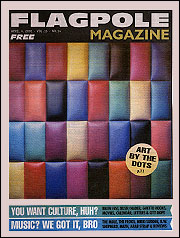 Meet the PopTarts: Sally, Rinne, Rebecca and Maren. Four nice young ladies in short-skirted nurse's whites and black go-go boots, with their names emblazoned across the pocket in hot pink. The smell of warm pastry fills the Tate Student Center. Young people with backpacks and middle-aged townies with kids queue up at four red-hot toasters to request chocolate milk or regular, with a straw. Each receives a free, not-so-nutritious American breakfast favorite, on a dainty napkin. Children swarm in the center of the room, hopped up on sugar, sprawling over Didi Dunphy's rainbow-hued upholstered geometric forms. Little fingers leave trails of saliva across the Naugahyde. In the distance, aspiring intellectuals peer thoughtfully up at Carol John's monumental triptych, "Big Pink #1, 2 & 3," a full ten feet high and blazing down upon us all in a million painted dots' worth of fluorescent megawatts. Everybody nods and smiles in recognition of one another. A buxom blonde poses before a smaller dot painting of muted blues and silvers, titled "Dot-Grey." Her wildly patterned blouse clashes perfectly. Someone snaps a photo.
WHAT: "Pop Tarts" by Carol John & Didi Dunphy
WHERE: Tate Student Center Gallery
WHEN: Through April 10
HOW MUCH: FREE!