
Circuit
Breaker
Issue #31, October 8, 1997
Glen Helfand
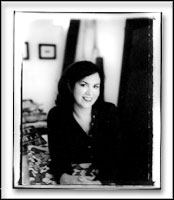
It's rare to find that mix of high-art smarts and pop-cultural glee, but artist Didi Dunphy manages to combine both into one bubbly package. This is a woman who, in the course of a brief conversation, can apply incisive cultural reference to her conceptually based artwork ("I have always considered the realm in which I critique or attack masculine modernism as one from a feminine hand") as well as to her flamboyant flip hairdo ("it's like Mary Tyler Moore in her Laura Petrie incarnation, but my liberal sensibility is closer to that of Mary on the 'Mary Tyler Moore Show'").
 Clearly,
she enjoys being-and pondering what it means to be a girl. Her artwork,
which has been exhibited in last summer's "Sexual Politics"
show at the Armand Hammer Museum, the Dan Bernier Gallery, and most recently
at l'ost in downtown L.A., comes in highly focused series' that manipulate
male-dominated codes of modernist art with female-identified techniques.
She's made minimalist paintings in designer colors (with zipper stripes),
abstract expressionist homages rendered in tie-dye, and textural quilt
"paintings."
Clearly,
she enjoys being-and pondering what it means to be a girl. Her artwork,
which has been exhibited in last summer's "Sexual Politics"
show at the Armand Hammer Museum, the Dan Bernier Gallery, and most recently
at l'ost in downtown L.A., comes in highly focused series' that manipulate
male-dominated codes of modernist art with female-identified techniques.
She's made minimalist paintings in designer colors (with zipper stripes),
abstract expressionist homages rendered in tie-dye, and textural quilt
"paintings."
Her current work, a series of embroideries that nod to the canon of contemporary art, reflects yet another aspect of womanhood. "I was pregnant, so I started entering the world of the miniature," Dunphy explains. "I figured my next manipulation within the arena of high modernism should be sewing, as a metaphor for wielding a paint brush." Since her advanced art degree from the San Francisco Art Institute didn't include training in cross-stitch, she describes the practice as "self-taught."
It's
also one that's adaptable to traditional roles of motherhood arid family.
While embroidering in the Venice home she shares with her husband, artist
Jim Barsness, she can also keep an eye on their "darling daughter" Lucy.
"My studio became my Shaker sewing box, it can go anywhere at any
time."
The subjects
of Dunphy's "Samplers" are her "remembrance or general consciousness"
of postwar modernist art. She's aped Frank Stella's brooding black paintings
("but they're pink") and created three inch Mondrian-style compositions
she calls "Petite Piets." One female artist, Agnes Martin, is
represented in the bunch. "I think that's the correct ratio in the
art world, 30 male artists to one female," she says tartly.
But Dunphy's work is gracious, not bitter "They're not a hostile
act," she explains. "They're really an equal balance of me admiring
modernism and the artists who generated it, and me dissing them."
Indeed, trashing the art world would hardly be in her best interest, as she's a very visible, enlivening presence in the L.A. scene both academically and socially. She's taught a class on art forgery (a subject that fascinates her) at U.C. Irvine, and as the president of the board of trustees of the soon-to-relocate Santa Monica Museum, Dunphy's busy spearheading a capital campaign for the new building.
While doing all that, and formulating a new series, Dunphy still manages
to find time to apply her aesthetic skills to more playful aspects of
womanhood. "For the fall, I think I'm going to wear hyacinth nail
polish," she winks.