
San Francisco
Chronicle: Datebook
Saturday, March 26, 1994
Kenneth Baker: Chronicle Art Critic
Snickerdoodles
'Snickerdoodles at Southern Exposure
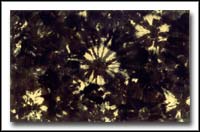
New work by California painter Didi Dunphy is the strong reason to see a group show called "Snickerdoodles" at Southern Exposure, 401 Alabama Street (through April 16). The others represented here are Timothy Buckwalter, Bruce Hogeland, Mike Terry and Cindy Workman.
Dunphy makes non-figurative paintings, more objects than pictures, with ironic references folded into them.
Two of her new works result from quilting canvas triangles and rectangles onto a gridded, creased canvas ground. Each patchwork surface was painted (black in one case, white in the other) and then apparently sanded and varnished to achieve an indifferently speckled look like that of shopworn synthetic yard goods.
These paintings confound the tradition of systemic abstraction with the "woman's art" of quilting. (I wonder if Dunphy is aware of Dorothea Rockburne's folded canvas "Egyptian" series of the late '70s.)
Dunphy has fixed the canvas grounds of her pictures to the outside edges of their stretchers with even rows of brass upholstery tacks, lending them an air of domestic fussiness. Abstract art is not supposed to let on that serving as decor is its best chance to survive, but like a bratty sister, hers does.
Dunphy also shows several big paintings from a series made by tie-dyeing. These inky black and monochrome blue images are abstract paintings, though their smoky lights and darks inadvertently hint at images such as fuzzy caterpillars and gone-to-seed dandelions.
More to the point, they pollute with hippie chic the staining technique with which Helen Frankenthaler and Morris Louis elevated the possibilities of color field painting in the late '50s and early '60s.
Those possibilities did not gain much, Dunphy seems to believe, relative to the carnival that popular culture would become in the same decades. Her deadpan superimposition of styles, sealed with varnish, allows her to generate irony and sincere remembrance without their canceling each other out.
Cindy Workman has spared no effort in putting together big, framed arrays of solid-color discs and round, enlarged vignettes from old comic books: the work looks equidistant from John Baldessari and Pop art‹critically a tight spot.
Timothy Buckwalter's plunder of magazine cartoons bespeaks a nice, tough hand, but the apparent influence of Richard Prince works on it like Kryptonite.
It is Dunphy who really owns the show, though, owing to how thought through her work appears.